Session as part of the Festival des Cinémas Différents et Expérimentaux de Paris.
FOCUS #6 - Matières en partage
Séance programmée par Tomaz Burlin
‘Expanded cinema’ refers to a range of practices that take the moving image beyond the traditional cinema setting. Developed particularly from the 1960s onwards, in dialogue with performance art, installation art, happenings and video art, these forms treat projection as a plastic, spatial and performative medium.
Whilst the term ‘expanded cinema’ became widely used in the 1960s, the movements that pushed its boundaries emerged earlier. In Paris, as early as the 1950s, the Lettrist cinema of Isidore Isou and Maurice Lemaître challenged the limits of traditional projection; with ‘syncinema’, developed by Lemaître, the cinema auditorium, the screen, the audience and the actions accompanying the screening became an integral part of the work. In the 1960s and 1970s, this experimentation continued and expanded within filmmakers’ cooperatives, collectives and self-managed spaces. In New York, centred on the Film-Makers’ Cooperative founded notably by Jonas Mekas, and in London, within the London Film-Makers’ Co-operative, artists such as Stan VanDerBeek, Carolee Schneemann, Malcolm Le Grice, Lis Rhodes, Annabel Nicolson and William Raban invented new forms of projection and performance. In continental Europe, VALIE EXPORT and Peter Weibel in Vienna, and Birgit and Wilhelm Hein in Cologne, were simultaneously developing practices in which projection, the body, the installation and space became inseparable. In France, Claudine Eizykman and Guy Fihman carried this momentum forward with the Paris Films Coop and later Cinédoc, combining creation, research and the collective organisation of distribution. Expanded cinema thus flourished in a context where formal experimentation went hand in hand with a desire for autonomy: the sharing of tools, the circulation of works outside commercial circuits, and the challenging of cinema’s traditional hierarchies.
This collective and independent dimension continues today in self-managed film laboratories, which ensure the passing on of film-making expertise whilst remaining spaces for research, mutual support and experimentation. Several of the evening’s artists have emerged from these networks: Agnès Perrais and Julien Pluchard are members of L’Etna and L’Abominable; Labodoble, founded by Alexandra Moralesová and Georgy Bagdasarov, is both an artistic duo and an independent laboratory based in Prague; in Marseille, Alyzée Soudet-Polaris is active at Labo L’Argent. Sergej Vutuc, whose practice is more nomadic, maintains close links with various independent venues and networks within the experimental scene. With a background more in sound art, Méryll Ampe also forms part of this constellation through his collaborations and a practice regularly presented in the contexts of music, performance and experimental cinema, particularly at festivals.
In this context, the screening itself becomes a space for experimentation. The single screen can be replaced by several surfaces, whilst the projector, lighting, objects, bodies and sound sources become visible components of the work. The film is no longer merely screened: it is activated within a specific venue, according to a specific temporal framework and presentation conditions.
Expanded cinema thus naturally transcends the framework of traditional screening to take the form of performances, temporary installations or audiovisual set-ups, in a wide variety of venues and configurations.
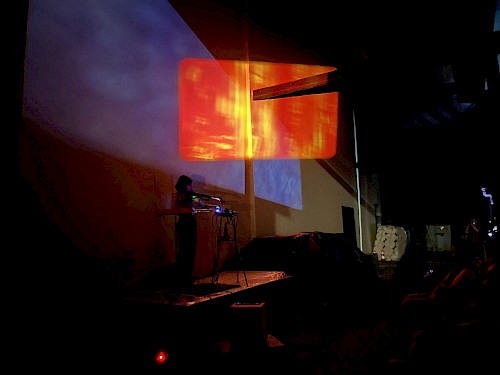
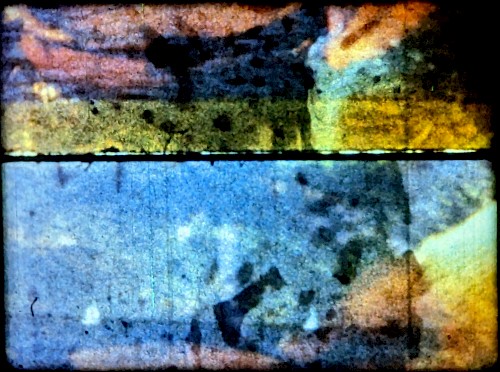
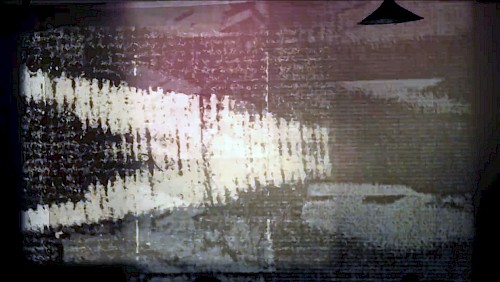
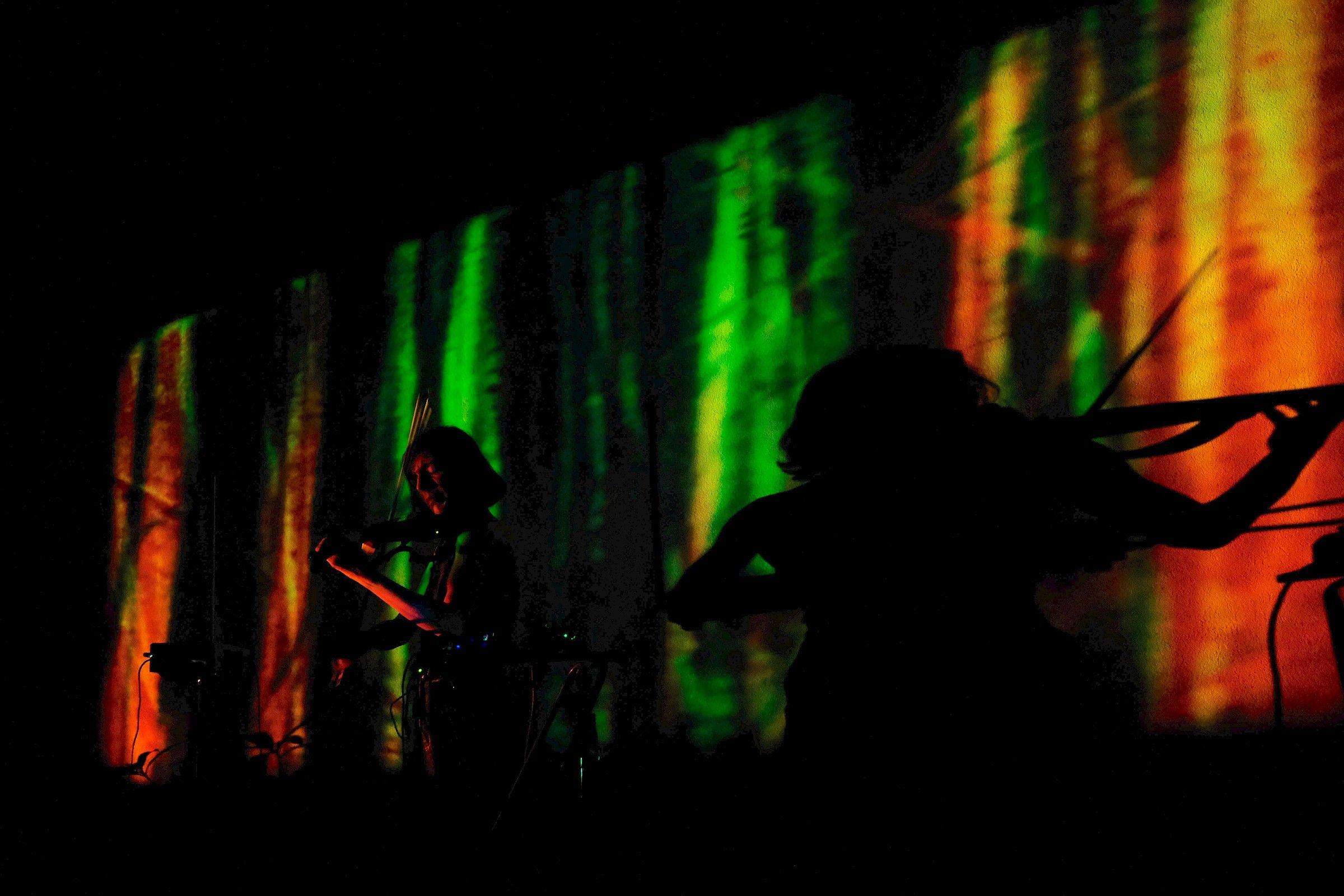
The evening programme organised by the CJC brings together three performances, each of which explores in its own way this relationship between image, sound and the apparatus. *Deux forêts*, by Agnès Perrais, Julien Pluchard and Alyzée Soudet-Polaris, combines a dual 16 mm projection with a live sound improvisation. *Submemorias de un rollo*, by Labodoble — Alexandra Moralesová and Georgy Bagdasarov — utilises three 16 mm projectors and sound to explore memory, the extraction of resources and the materiality of film. REMINDER, by Méryll Ampe and Sergej Vutuc, blends 16 mm loops, photocopying, analogue synthesis and mechanical manipulations; in this piece, Méryll Ampe processes the sound in real time using synthesisers, modular systems and drum machines.
In all three cases, the screening becomes a performance: images, sounds and equipment are manipulated live, and the work takes shape in the very moment of its presentation. This focus on the set-up, the space and the conditions of activation makes each performance a unique experience, one that cannot be reduced to a mere audiovisual recording.
The evening thus extends the exploration of the theme ‘Un.e ET Un.es’: each artist asserts a personal artistic voice, whilst situating their practice within a shared framework of collaborations, presences, techniques and shared responsibilities.